基本信息
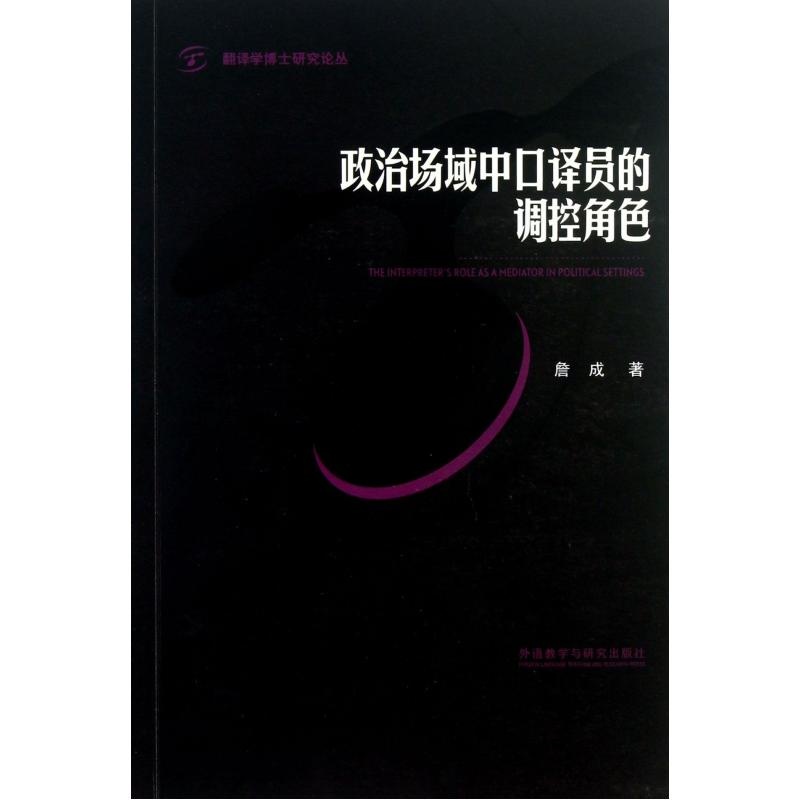
| 商品名称: | 政治场域中口译员的调控角色/翻译学博士研究论丛 |
| 作者: | 詹成 | 开本: | 16开 |
| 原价: | 59.9
| 页数: | 247 |
| 现价: | 56.499 | 出版时间 | 2013-04-01 |
| ISBN号: | 9787513530194 | 印刷时间: | 2013-04-01 |
| 出版社: | 外语教研 | 版次: | 1 |
| 商品类型: | 图书 | 印次: | 1 |
内容提要
《政治场域中口译员的调控角色》首先采用文献 计量法和归纳法,系统梳理国际范围内对译员 角色研究的发展历史、研究主题和研究方法;然后对广东省人民政府机 构译员的真实口译工作进行描写、建构平行语料库; 再运用批评性话语 分析的方法对语料进行定性研究,考察了口译过程中不同层次的“偏移” 现象,如零转换、概括转换、缩减转换、替代转换和 扩展转换,分析政 府机构译员在政治会谈口译中,如何通过人称转换、信息增减、交际功 能调整等,对话语内容进行调控。《政治场域中口译 员的调控角色》由詹成所著。
目录
List of Diagrams List of Tables Chapter 1 Setting the Scene forThis Research 1.1 Rationale of Research 1.2 Research Objective 1.3Significance of Research 1.3.1 Understanding the social face of theinterpreting profession 1.3.2 Enriching academic research oninterpreting 1.4 Research Scope 1.4.1 Consecutive interpreting1.4.2 Political settings 1.4.3 Government staff interpreters 1.4.4Guangdong Province 1.4.5 Role 1.5 Research Methodology 1.5.1 DIparadigm and methodologies in interpreting studies 1.5.2De*ive study of interpreting 1.5.3 Critical discourse analysisof interpreted events documented in corpus 1.6 Thesis OrganizationChapter 2 Previous Literature and Theoretical Framework 2.0 ChapterOverview 2.1 Describing CI Activities in SocioculturalInteractional Contexts 2.2 Translation as Re-writing and ItsRelevance to Interpreting 2.2.1 The Re-writing Theory intranslation studies 2.2.2 Applying the Re-writing Theory tointerpreting studies 2.3 Research on Ideology and Mediation inTranslation and Interpreting 2.3.1 Ideology and mediation intranslation activities 2.3.2 Ideology and mediation in interpretingactivities 2.3.3 Ideology and mediation--a summary 2.4 Research onthe Role of the Interpreter 2.4.1 The interpreters role as animportant topic of research 2.4.2 The interpreters role in varioussettings of the profession 2.4.3 Going beyond previous research---asummary 2.5 Critical Discourse Analysis of Interpreter-mediatedEncounters 2.5.1 The power of critical discourse analysis 2.5.2Adopting critical discourse analysis in interpreting studies 2.5.3Critical discourse analysis--a framework for analysis 2.6Theoretical Framework of This Research 2.7 Summary of This ChapterChapter 3 Analyzing CI in Political Settings with a Parallel Corpus3.0 Chapter Overview 3.1 Constructing a Corpus for This Research3.1.1 Some background features of interpreter-mediated politicalmeetings 3.1.2 Source of the corpus data 3.1.2.1 Meetings to bestudied 3.1.2.2 Collection of the data 3.1.3 Selection of thecorpus data 3.1.3.1 The primary parties of communication 3.1.3.2The time span of the meetings 3.1.3.3 The languages used in themeetings 3.1.3.4 The interpreters involved 3.1.3.5 The pattern ofturn-taking in the meetings 3.1.4 Preparing the data for analysis3.1.4.1 Tran*ion of the data 3.1.4.2 Documentation andcalculation 3.2 Exploring "Shifts" in the Interpreted Texts 3.3Presenting Corpus Data upon Quantitative Analysis 3.4 Summary ofThis Chapter Chapter 4 Shifting Personal Angles in the Re-Narrationof "Self" and the "Other" 4.0 Chapter Overview 4.1 InterpretingPolitical Encounters as a Process of Re-Narration 4.2 Questioningthe Interpreters Identity as a Non-person 4.3 Shifts in PersonalAngles---Case Analysis 4.3.1 First person vs. third person as theconstructing of"Us" 4.3.1.1 First person angle to third personangle 4.3.1.2 Third person angle to first person angle 4.3.2 Secondperson vs. third person as the constructing of the "Other" 4.3.2.1Second person angle to third person angle 4.3.2.2 Third personangle to second person angle 4.3.3 Singular vs. plural as areference to the collective community 4.3.4 Animate vs. non-animateas a reflection of the knowledge system 4.3.4.1 Animate subject tonon-animate subject 4.3.4.2 Non-animate subject to animate subject4.3.5 Shifting the speaking subject as a way of active mediation4.4 Interpreters Perception and Projection of the "Self" 4.4.1 Theidealized interpreter vs. the actual interpreter 4.4.2 Howprofessional interpreters understand their multiple identities 4.5Summary of This Chapter Chapter 5 Managing and Mediating DiscourseThrough Shifts in Interpreted Political Meetings 5.0 ChapterOverview 5.1 Interpreting Political Meetings as an Act of Mediation5.2 Levels of Renditions Examined in the Corpus Data 5.3 ExtendedRenditions 5.3.1 Addition of hedges 5.3.2 Explicitations withcontext 5.3.3 Means of Advocacy 5.4 Substituted Renditions 5.4.1Shifts in speech acts 5.4.2 Modality changes 5.4.3 Interventionsfrom presupposed knowledge 5.5 Reduced Renditions 5.5.1 Informationfiltering 5.5.2 Cultural broking 5.6 Para-discourse on InterpreterMediation in Political Settings 5.7 Summary of This Chapter Chapter6 The Interpreters Voice in Political Meetings 6.1 ResearchFindings 6.2 The Voice of the Interpreter--Conclusion of ThisResearch 6.3 Implications of This Research 6.3.1 De*ive studyof actual interpreting in its context 6.3.2 Interpreting activitiesexamined with social and cultural theories 6.3.3 Analysis with aparallel corpus of interpreting of political meetings 6.3.4Practice, training and development of the profession 6.4Limitations of This Research 6.5 Suggestions for Future ResearchBibliography Appendix 后记