基本信息
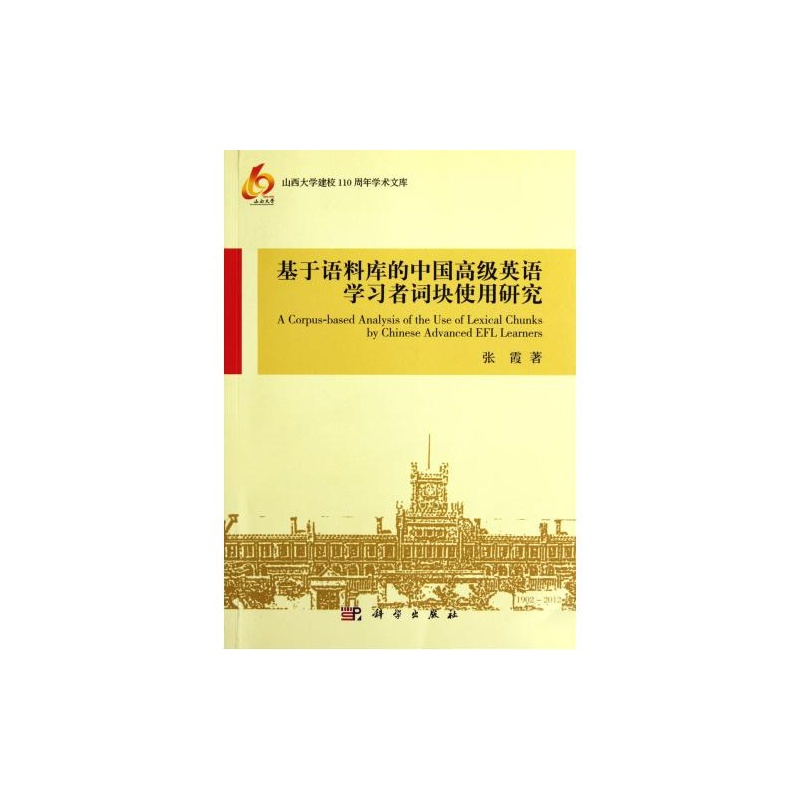
| 商品名称: | 基于语料库的中国高级英语学习者词块使用研究/山西大学建校110周年学术文库 |
| 作者: | 张霞 | 开本: | 16开 |
| 原价: | 48
| 页数: | 199 |
| 现价: | 39.3 | 出版时间 | 2012-05-01 |
| ISBN号: | 9787030339782 | 印刷时间: | 2012-05-01 |
| 出版社: | 科学 | 版次: | 1 |
| 商品类型: | 图书 | 印次: | 1 |
内容提要
词块集中体现了语言使用中规约性与创新性的辩证统一,词块使用特 征往往提示出文本构成的机制以及学习者的语言能力特征。《基于语料库的中国高级英语学习者词块使用研究》(作者张霞)设计了一套行之有效的 词块抽取和赋码方案,并将之应用于中国高级英语学习者词块使用的调查分析,从结构功能和词汇语法两个层面考察了学习者和本族语者使用词块 的趋势;还对学习者和本族语者、母语不同的学习者、学习者和教材用法进行了对比分析,旨在揭示学习者用法中产生偏差的内在机理,以期对教 学有所启示。《基于语料库的中国高级英语学习者词块使用研究》适合高校英语教 师、语言学类研究人员、高效在读语言学类研究生及对语言量化研究感兴趣的本科生阅读。
作者简介
女,山东章丘人,汉族。山西大学外国语学院教师,上海交通大学博士毕业。主要研究方向为语料库语言学。
目录
总序 Acknowledgements Introduction Chapter I Lexical Chunks andLanguage De*ion 1.1 The conventional use of language as along-standing and long-recognized phenomenon 1.1.1 A de facto,long-standing and wide-spread phenomenon 1.1.2 A long recognizedphenomenon 1.2 The centralization of conventional language inneo-Firthian researches 1.2.1 The difference between thefunctionalist and mentalist paradigms 1.2.2 From meaning andfunction to the conventional use of language 1.2.3 How neo-Firthianarguments solve the problem of productivity 1.3 Lexical chunks asrepresenting conventionality in language use 1.3.1 The nature oflexical chunks 1.3.2 Features of lexical chunks 1.4 A review of themethodology development in studies of lexical chunks 1.4.1 Themarginalization of phraseology and the salience approach 1.4.2 Thecentralization of phraseology and the statistical approach 1.4.3Altenberg, Biber and the study of lexical chunks 1.5 SummaryChapter 2 Lexical Chunks and Language Acquisition 2.1 A comparison2.2 Holistic language processing and FLA 2.2.1 Explanatory adequacyand the alternative expediency 2.2.2 Holistic language processingand the route of FLA 2.2.3 The role of holtic language processingin FLA 2.3 Lexical chunks and SLA 2.3.1 Differences andsimilarities between advanced EFL learne and fit language acquiringchildren 2.3.2 Lexical chunks and the route of SLA 2.3.3 Lexicalchunks and the success of SLA--the social-functional level 2.3.4Lexical chunks and the success of SLA--the lexico-grammatical level2.3.5 Lexical chunks and the success of SLA--extant studies 2.4Procedural vocabulary and lexical chunks 2.4.1 The conception ofprocedural vocabulary 2.4.2 The relatiohip between proceduralvocabulary and lexical chunk 2.5 Deviatio in learne' use of lexicalchunks--de*ion and diagnosis 2.5.1 Two kinds of deviatio andtwo approaches to the diagnosis 2.5.2 The CIA approach and thediagnosis of learner deviatio 2.5.3 The research questio of thepresent research 2.6 The acquisition of lexical chunks in theclassroom context 2.7 Summary Chapter 3 The Methodology 3.1 An NLPpepective of the study of lexical chunks 3.1.1 Hybrid algorithms3.1.2 Association measures 3.1.3 Statistical algorithms to decideMWU boundary 3.1.4 Dispeion 3.1.5 The extraction of proceduralvocabulary 3.1.6 The automatic extraction of patter around acertain word 3.2 The methodology of the present study 3.2.1 Corporaused-size, sampling and preprocessing 3.2.2 The extraction oflexical chunks: length range, frequency, dispeion and boundarydetermination 3.2.3 The filtering process 3.2.4 Tools of lexicalchunk extraction 3.2.5 Annotation 3.2.6 The extraction of PV 3.2.7Word-form based lexical chunks and POS-tag sequences around PV 3.3The research design of the present study Chapter 4 Word-form BasedLexical Chunks 4.1 The proportion issue 4.2 Types and toke oflexical chunks in different length categories 4.3 Types, toke andtype/token ratio of lexical chunks in different corpora 4.4 Thestructure and function characteristics of lexical chunks 4.4.1Dependent clause 4.4.2 Independent clause 4.4.3 Single clausecotituent 4.4.4 Incomplete phrase 4.4.5 Multiple clause cotituents4.4.6 The interaction between function and corpus 4.5 Discussionand summary Appendix: Complementary statistical analyses Chapter 5POS-tag Sequences Around PV 5.1 Procedural words in the fourcorpora 5.1.1 Rank correlation analysis 5.1.2 Distribution ofcontent and function words 5.1.3 Distribution of PV of variousparts of speech 5.2 The relatiohip between procedural words andlexical chunks 5.2.1 The proof of the close relatiohip between PVand lexical chunks 5.2.2 De*ive statistics 5.3 proceduralwords common to the corpora under study 5.3.1 Analysis of take5.3.2 Analysis of make 5.3.3 Analysis of time and way 5.4 SummaryAppendix: Complementary statistical analysis Chapter 6 MajorFindings Revisited 6.1 Major findings and conclusio 6.2 Limitatioand prospects 6.2.1 Higher degree of abstractness 6.2.2 Semanticprosody and discoual functio 6.2.3 The developmental dimeion 6.2.4Procedural vocabulary References Appendix