
图书简介
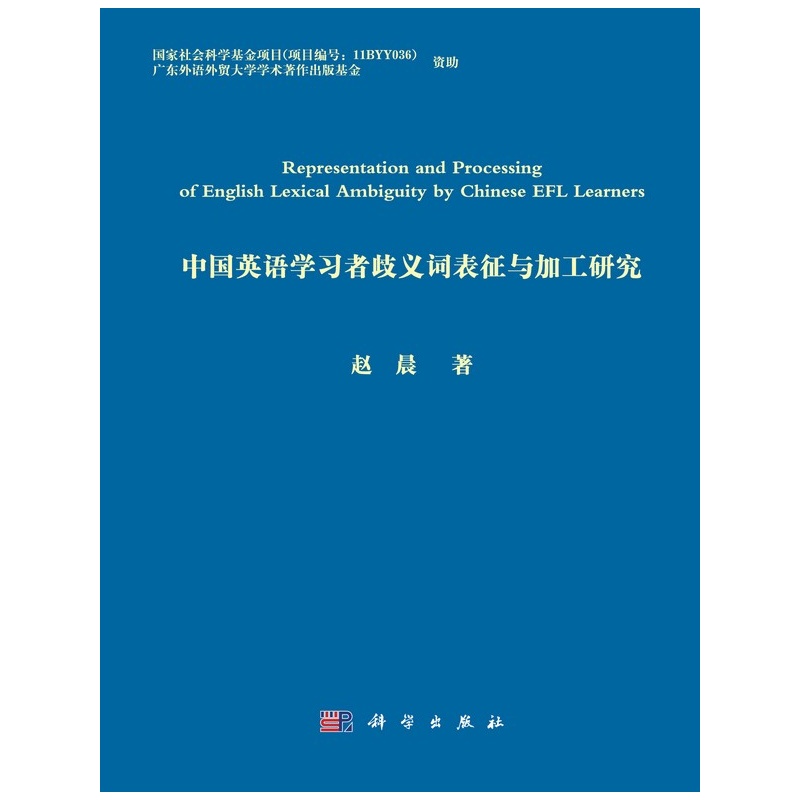
Representation and Processing of English Lexical Ambiguity by Chinese EFL Learners(中国英语学习者歧义词表征与加工研究)从词汇语义表征形成与发展的角度,探讨了中国英语学习者在词汇表征建构的不同阶段、词汇多义不同纬度(三种歧义词)的通达特征。研究发现,中国英语学习者的歧义词表征是一个发展的模式:同形歧义词和转喻多义词的心理表征随学习者英语水平的提高而更具分立性;但在转喻多义这个维度上,词义之间的联系强度不是随着语言水平的提高而减弱,而是相反。就不同歧义词的通达特征而言,中国英语学习者通达三种歧义词的特点相同,都遵循顺序通达模式。这充分体现了基于用法理论的语言学习观。
目录
Contents
前言
Abstract
Chapter 1 Introduction
1.1 Research Orientation
1.2 Definition of Lexical Ambiguity
1.3 Rationale for the Study
1.4 Research Questions
Chapter 2 Previous Studies of Lexical Ambiguity Resolution:General Issues
2.1 Introduction
2.2 Meaning Representation
2.2.1 Hierarchical Network Models
2.2.2 Activation Spreading Models
2.2.3 Distributed Memory Model
2.3 Word Recognition and Lexical Access
2.3.1 The Search Model
2.3.2 The Logogen Model
2.3.3 The Cohort Model
2.3.4 Factors Influencing Lexical Access
2.4 Semantic Priming
2.5 Second Language Lexicon
2.6 Summary
Chapter 3 Previous Studies of Lexical Ambiguity Resolution:Theoretical Models and Empirical Evidence
3.1 Introduction
3.2 Previous Studies of Homonymy Processing in L1
3.2.1 Fodor's Modularity Hypothesis
3.2.2 Five Models of Homonymy Processing in L1
3.3 Previous Studies of Suppression Mechanism in Homonymy Processing
3.4 Previous Studies of Homonymy Processing in L2
3.5 Previous Studies of Polysemy Processing in L1
3.5.1 Representation of Polysemous Words
3.5.2 Previous Studies of Polysemy Effects
3.5.3 Processing of Polysemy in L1
3.6 Previous Studies of Polysemy Processing in L2
3.7 Comments on the Previous Studies of Lexical Ambiguity Resolution
3.8 Summary
Chapter 4 Previous Studies of Lexical Ambiguity Resolution:Experimental Tasks
4.1 Introduction
4.2 Experimental Techniques
4.2.1 Ambiguity Detection Method
4.2.2 Processing Complexity Tasks
4.2.3 Priming Paradigm
4.3 The Nature of Sentential Context
4.4 The SOA Conditions
4.5 Comments on the Experimental Tasks
4.6 Summary
Chapter 5 Research Questions and Hypotheses
5.1 Introduction
5.2 Linguistic and Psycholinguistic Models Related to the Present Study
5.2.1 Ambiguous Words in Mind:Linguistic Models
5.2.2 Disambiguation of Lexical Ambiguity:Psycholinguistic Models
5.3 Research Questions
5.4 Hypotheses
5.5 Experimental Design and Predictions
5.5.1 Experiment One
5.5.2 Experiment Two
5.5.3 Experiment Three
5.6 Summary
Chapter 6 Experiment One:Selecting Contextually Appropriate Meanings
6.1 Introduction
6.2 Preparatory Studies
6.2.1 Preparatory Study I
6.2.2 Preparatory Study II
6.2.3 Preparatory Study III
6.3 Experiment One
6.3.1 Hypothesis,Design and Predictions
6.3.2 Participants
6.3.3 Materials
6.3.4 Procedure
6.3.5 Results
6.3.6 Discussion
6.4 Summary
Chapter 7 Experiment Two:Suppressing Contextually Inappropriate Meanings
7.1 Introduction
7.2 Experiment Two
7.2.1 Hypothesis,Design and Predictions
7.2.2 Participants
7.2.3 Material
7.2.4 Procedure
7.2.5 Results
7.2.6 Discussion
7.3 Summary
Chapter 8 Experiment Three:Representation of English Lexical Ambiguity
8.1 Introduction
8.2 Experiment Three
8.2.1 Hypothesis,Design and Predictions
8.2.2 Participants
8.2.3 Materials
8.2.4 Procedure
8.2.5 Results
8.2.6 Discussion
8.3 Summary
Chapter 9 General Discussions
9.1 Introduction
9.2 Discussion of Lexical Ambiguity Resolution Theories
9.2.1 L2 Processing of Homographs:The Ordered-Access Model
9.2.2 L2 Processing of Metonymic Polysemy:Specified,Not Underspecified
9.2.3 Comparison of the Processing of Different Ambiguous Words
9.3 L2 Lexical Ambiguity Resolution and Reading Comprehension
9.4 Summary
Chapter 10 Conclusions
10.1 Introduction
10.2 Conclusions
10.2.1 Conclusions about the Experiments
10.2.2 A Unified Picture for L2 Resolution of Lexical Ambiguity
10.3 Limitations and Suggestions for Future Studies
10.3.1 Limitations
10.3.2 Suggestions for Future Studies
10.4 Implications
10.4.1 Theoretical Implications
10.4.2 Pedagogical Implications
10.5 Summary
Bibliography
Appendices
Appendix A:Ambiguous Words for Judgment
Appendix B:A Sample of Materials Used in Preparatory Study II
Appendix C:Dominance and Familiarity of the Ambiguous Meanings
Appendix D:Primes with Sentential Contexts and Their Targets
Appendix E:The Sense Relatedness Questionnaire
List of Tables
3-1 Experimental Materials Used in Swinney(1979)
3-2 Example Sentences Used in Frazier & Rayner(1990)
3-3 Sample Sentences Used in Pickering & Frisson(2001)
5-1 Kinds of Evidence Adduced by Croft
5-2 Predictions of Experiment One
5-3 Predictions of Interference Effects of Experiment Two
6-1 Word Length and Frequency of Related and Unrelated Primes
6-2 Tests of Word Length of Related and Unrelated Primes
6-3 Tests of Frequency of Related and Unrelated Primes
6-4 Participant Data in Terms of Age and Language Skills
6-5 Results of One-Way ANOVA Tests of Participants'Data between 200 ms Group and 500 ms Group
6-6 Results of One-Way ANOVA Test of Participants'Data between High and Low Proficiency Group
6-7 Sample Materials for Experiment One
6-8 Distribution of Participants and Experiment Trials
6-9 Data Deleted due to Incorrect Response,Outliers and Unknown Meanings
6-10 Mean RT(ms),SD(ms)and Errors by SOA,Subject Group,Frequency,Ambiguity Type and Sentence Type
6-11 Tests of Within-Subjects Effects(by participants)
6-12 Tests of Between-Subjects Effects(by participants)
6-13 Tests of Between-Subjects Effects(by items)
6-14 Tests of Within-Subjects Effects(by items)
6-15 The Results of Step-down Analysis of Relatedness by Dominance and Context(By participants)
6-16 The Results of Step-down Analysis of Relatedness by Dominance and Context(By items)
6-17 Priming Patterns across Proficiency Group and SOA Condition
7-1 Participants'Data in Terms of Age and Language Skills
7-2 Results of One-Way ANOVA Tests of Participants'Data between 200 ms and 500 ms
7-3 Results of One Way ANOVA Tests of Participants'Data between High and Low Proficiency Group
7-4 A Sample of Materials for Experiment Two
7-5 Data Deleted Due to Outliers and Unknown Meanings
7-6 Mean RTs(ms)to Related and Unrelated Targets across Proficiency,ISI,Ambiguity Type and Dominance
7-7 Tests of Within-Subjects Effects(by participants)
7-8 Tests of Between-Subjects Effects(by participants)
7-9 Tests of Within-Subjects Effects(by item)
7-10 Tests of Between-Subjects Effects(by item)
7-11 Step-down Analysis of Relatedness for Homograph Targets(by participants)
7-12 Step-down Analysis of Relatedness for Homograph Targets(by items)
7-13 Step-Down Analysis of Relatedness for Metaphoric Polysem Targets(by participants)
7-14 Step-down Analysis of Relatedness for Metaphoric Polysem Targets(by items)
7-15 Step-down Analysis of Relatedness for Metonymic Polysem Targets(by participants)
7-16 Step-down Analysis of Relatedness for Metonymic Polysem Targets(by items)
7-17 Mean PC(percentage of correctness)and SD by ISI,Proficiency,Meaning Frequency and Sentence Type
7-18 One-Sample Kolmogorov-Smirnov Test of Normality(by participants)
7-19 One-Sample Kolmogorov-Smirnov Test of Normality(by items)
7-20 Results of Wilcoxon Sign Ranks Test for the By-Participants Data
7-21 Wilcoxon Sign Ranks Test or ANOVA Test for the By-Items Data
7-22 Interference Patterns Obtained from RT and PC Analysis
8-1 Mean Scores across Proficiency and Ambiguity Type
8-2 Results of ANOVA Tests of Between-Subjects Effects
8-3 Analysis of Variance of the Scores for the Low Proficiency Group
8-4 Analysis of Variance of the Scores for the High Proficiency Group
8-5 Post Hoc Tests for Data of Low Proficiency Group
8-6 Post Hoc Tests for Data of High Proficiency Group
8-7 Analysis of Variance of Scores for Homonymy between Low and High Proficiency Group
8-8 Analysis of Variance of Scores for Metaphoric Polysemy between Low and High Proficiency Group
8-9 Analysis of Variance of Scores for Metonymic Polysemy between Low and High Proficiency Group
List of Figures
1-1 Classification of Lexical Ambiguity
2-1 Processing Modules in the Distributed Memory Model(Masson,1995:5)
2-2 Word Recognition in Forster's Search Model
3-1 A Continuum of the Five Models
5-1 Croft's Representation Model of Ambiguous Words
5-2 Tuggy's Model of Polysemic Representation
5-3 A Model of Homonymy and Polysemy Representation
5-4 An Alternative Model of Ambiguous Representation
5-5 A Developmental Model of Chinese EFL learners'Ambiguous Representation
6-1 A Sample of E-Prime Program of Experiment One
8-1 A Developmental Model of EFL Ambiguous Representation
9-1 L2 Representation of Homonymy
9-2 L2 Representation of Metonymic Polysemy
9-3 A High-Quality Representation for the Word Gate(Cited from Perfetti & Hart,2002:70)
同类热销图书
| 书名 | 作者 | 出版社 | 价格 | 购买 |
| 如何巧妙设计英语课堂(剑桥英语课堂教学系列)——英语教师.. | (英)伍德.. | 外语教学与研究出.. | ¥34.90¥28.50 |
详情 |
| 演讲的艺术(第十版/中国版)(配CD-ROM光盘)——全球演讲圣.. | (美)卢卡.. | 外语教学与研究出.. | ¥48.90¥40.00 |
详情 |
| 新编简明英语语言学教程学习指南 (戴炜栋、何兆熊版《新.. | 牟杨 主编 | 西南交大 | ¥14.00¥9.40 |
详情 |
| 怎样教英语(新版)(语言学文库)——中国规模最大最具影响力.. | (英)哈默.. | 外语教学与研究出.. | ¥27.90¥22.80 |
详情 |
| 新编简明英语语言学教程(第2版)学习指南 (配套戴炜栋、.. | 牟杨 著 | 西南交通大学出版.. | ¥21.00¥15.80 |
详情 |
| 汉英对比语言学 | 陈德彰 编.. | 外语教学与研究出.. | ¥45.90¥36.20 |
详情 |
| 如何设计课堂泛读活动(剑桥英语课堂教学系列)——英语教师.. | (英)班福.. | 外语教学与研究出.. | ¥29.00¥23.20 |
详情 |
| 如何使用影像材料进行课堂教学(剑桥英语课堂教学系列)——.. | (英)舍曼.. | 外语教学与研究出.. | ¥37.00¥29.60 |
详情 |
| 如何开展个性化课堂教学(剑桥英语课堂教学系列)——英语教.. | (英)格里.. | 外语教学与研究出.. | ¥22.90¥18.30 |
详情 |
| 在语境中教语言(圣智英语教师丛书) | (美)赫德.. | 外语教学与研究出.. | ¥58.90¥48.10 |
详情 |
| 英语语音学与音系学实用教程(语言学文库-第3辑)——中国规.. | (英)罗奇.. | 外语教学与研究出.. | ¥39.90¥31.90 |
详情 |
| 美英报刊导读(第二版) | 周学艺 编.. | 北京大学出版社 | ¥56.00¥47.80 |
详情 |
| 语料库应用教程——全国高等学校外语教师教学实践系列(附.. | 梁茂成,李.. | 外语教学与研究出.. | ¥43.90¥35.90 |
详情 |
| 英语史 | 李赋宁 编.. | 商务印书馆 | ¥29.00¥25.10 |
详情 |
| 网络外语教学理论与设计 | 张红玲 等.. | 上海外语教育出版.. | ¥50.00¥39.90 |
详情 |
| 哈姆雷特(莎士比亚作品解读丛书·英文影印插图版) | (英)汤普.. | 中国人民大学出版.. | ¥39.00¥29.30 |
详情 |
| 西方语言学流派(新)——介绍西方语言学流派的最新力作 | 刘润清 编.. | 外语教学与研究出.. | ¥29.90¥23.90 |
详情 |
| 钱钟书英文文集 | 钱鍾书 �.. | 外语教学与研究出.. | ¥43.90¥35.10 |
详情 |
| 英语教学设计 | 鲁子问,康.. | 华东师范大学出版.. | ¥33.00¥26.40 |
详情 |
| 高校与中学英语教师合作行动研究的实践探索 | 王蔷,张虹.. | 上海教育出版社 | ¥40.00¥32.00 |
详情 |
| 英汉词汇对比研究(复旦博学·语言学系列) | 蔡基刚 著 | 复旦大学出版社 | ¥30.00¥23.80 |
详情 |
| 基于语料库的语言研究与教学应用 | 潘潘 著 | 中国社会科学出版.. | ¥47.00¥37.60 |
详情 |
| 任务型语言教学 | (澳)纽南.. | 外语教学与研究出.. | ¥34.00¥27.20 |
详情 |
| 现代外语教学与研究(2012) | 吴江梅 等.. | 中国人民大学出版.. | ¥45.00¥34.00 |
详情 |
| 英语习语的文化内涵及其语用研究 | 张镇华 等.. | 外语教学与研究出.. | ¥32.90¥24.70 |
详情 |
